Roberto M. Morales — HVAC Author & Educator
I'm an HVAC contractor in Miami. I've spent more than 20 years on service calls, in attics, on rooftops and inside electrical panels, and I write the books I wish someone had handed me in my first year.
I still run my company and still take calls. That's the basis of everything here: what I publish gets used on real equipment before it reaches a page.
The catalog has grown past the toolbox since then. I also write for homeowners who just want to understand their own system, practical books on using AI as a working tool, children's stories for kids who take things apart, and the Hot Work romance series set in the Miami construction world I know first-hand — in English and Spanish, in paperback, hardcover and Kindle.


How I learned this trade — and why I started writing about it
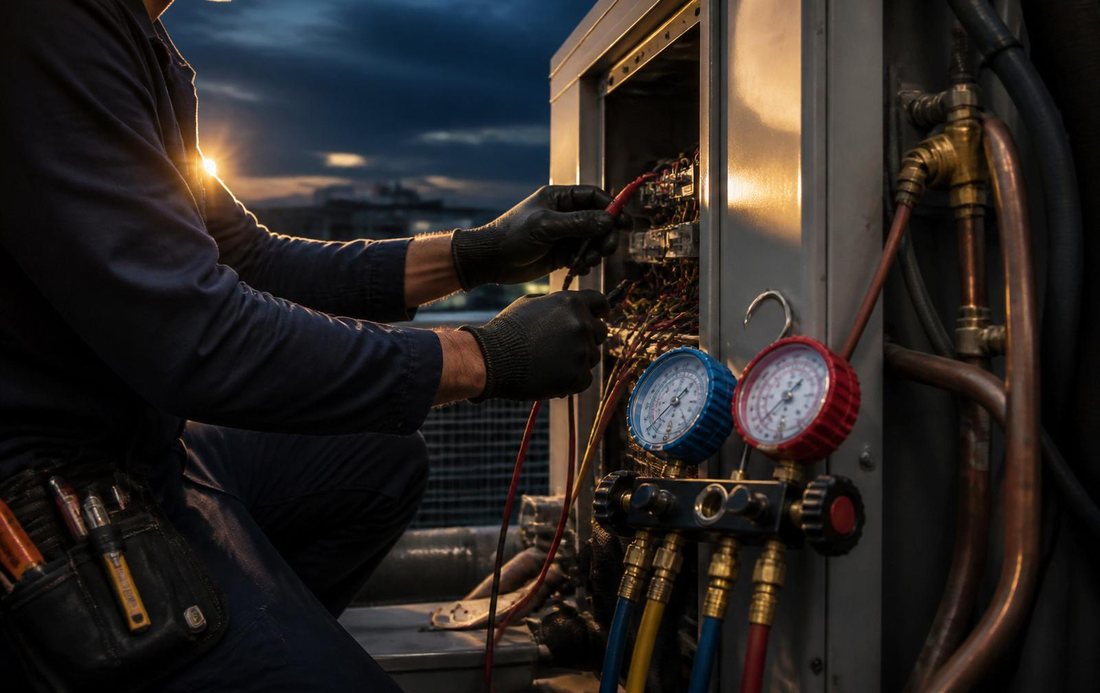
I started the way most technicians do: carrying gauges, following someone with more experience, and finding out fast that the manual rarely matches the attic. Miami is a hard place to learn cooling. Constant heat load, high humidity, salt air, and systems that never get a slow day. Equipment here shows its problems quickly, and so does a technician who is guessing.
I made the mistakes. I replaced parts that were never bad. I once chased a "bad compressor" that turned out to be a wiring problem I could have found in ten minutes with the right sequence. Those calls cost me money, and they cost me time standing in front of a customer with no answer. What changed my work wasn't a new tool. It was committing to an order of operations and refusing to skip a step.
Two decades later I run my own company: residential and light commercial service, installation and replacement, duct and airflow correction, electrical and control troubleshooting, and refrigerant-side diagnostics. Part of that job is training the technicians who work with me, and for years I kept drawing the same diagrams on the same scraps of paper for every new tech. One day I looked at a stack of those drawings and realized I had been writing a book without printing it.
So I wrote it, and then the next one. When a book of mine gives you a reading, a tolerance or a decision point, it's because that number settled an actual repair on an actual job.
"I don't want a technician to memorize my books. I want them to stop guessing — and to keep the money that guessing was costing them."
What I owe the technician holding the book
A misdiagnosis is never just a wrong answer. It's a part you paid for, a callback you drive back to on your own time, and a customer who starts to wonder whether you know what you're doing. Most of the technicians I've trained weren't careless. Nobody had ever taught them a method, so under pressure they reached for a guess.
What I try to do is simple: help you learn faster than I did, and help you avoid the expensive mistakes I already paid for. That means step-by-step teaching instead of theory alone, worked examples with real numbers, and diagrams big enough to read with a flashlight in your teeth. If a chapter can't hold up on a service call, it doesn't belong in the book.
Six rules every book has to pass
Most HVAC material is either too academic to use on a call or too shallow to solve anything. I write for the space in between: field-accurate, structured, and readable by a technician standing in front of a unit that will not run.
Write it so it reads in an attic
If a technician has to read a paragraph three times in a hot attic, I wrote it wrong. Short sentences, one idea at a time, and the drawing next to the words that explain it.
Technical accuracy, no shortcuts
Every reading, tolerance and sequence in my books came off real equipment. If I can't verify it in the field or against the manufacturer's data, it doesn't go on the page.
Practical application first
Theory matters when it changes what you do next. Each chapter ends where the work does: measure this, compare it to that, and here's the decision it points to.
A repeatable diagnostic order
Guessing costs parts, callbacks and trust. I teach a fixed sequence — verify, measure, compare, decide — so the same steps get you to the same answer in year one or year fifteen.
Books get revised
Equipment changes, codes change, and so do my books. Second editions exist because I keep finding better ways to explain something I already published.
Reader feedback shapes the next book
Technicians write to me about the part that finally clicked and the part that didn't. That decides what gets rewritten, what gets a bigger diagram, and what I write next.
Fewer guesses. Better technicians.
The trade loses time, parts and customers to guesswork. What I want is to put a clear, teachable diagnostic method in the hands of any technician who wants one: apprentices starting out, experienced techs shoring up a weak area, and owners training a crew.
Five worlds, one standard of writing
HVAC technical education is where I started and it stays first. But the catalog is wider than that now: guides for homeowners, practical AI books, children's stories, and a romantic-suspense series set in the construction world I work in every day. Different readers, same promise — say it clearly, make it true, and make it worth the price.
HVAC books for technicians
The core of the catalog: airflow, electrical wiring, refrigeration and full-system troubleshooting, taught in the same fixed order I use on a service call — verify, measure, compare, decide. Big diagrams, real numbers off real equipment, and second editions when I find a better way to explain something. Available in English and Spanish, in paperback, hardcover and Kindle.
Browse the professional libraryHVAC books for homeowners
You don't need to become a technician to stop overpaying for your comfort. These books explain what your system is actually doing, which noises and bills are warning signs, what maintenance genuinely matters, and how to tell an honest estimate from an expensive one — written in plain language, no trade jargon, no scare tactics.
Browse the homeowner guidesPractical AI books
I use AI every day to run a service business — quoting, scheduling, writing, research. So I wrote the books I needed: what these tools actually do, where they help, where they fail, and step-by-step ways to put them to work today. Same standard as my technical writing: one idea at a time, and an example you can copy immediately.
Browse the AI seriesChildren's books
Stories that treat curiosity as normal and taking things apart as a good instinct. Little Inventors and Young Engineers turn everyday machines into adventures, with warm illustration and language pitched right for early and middle readers. A kid who learns that questions have answers may end up building something one day — maybe even in this trade.
Browse the children's booksThe Hot Work romance series
Eight volumes of workplace romance and romantic suspense set in the Miami construction world I actually know: contracts, permits, job sites, and two people whose competence is the most attractive thing about them. It starts as a slow burn and turns into a thriller about corruption in the air a city breathes. The trades, the tension, and the truth.
Enter the Hot Work seriesEvery library, in one place
The HVAC libraries hold the deepest technical work. Underneath them are the homeowner guides, the AI series, the children's books, the Hot Work novels and the Spanish editions — every one of them a finished, published book you can buy today.
HVAC libraries
For the working technician and engineer.
BrowseThe clearest on-ramp into the trade.
BrowseUnderstand and protect your home.
BrowseOther publishing worlds
Let's find the right book for where you are
A first-year tech, an owner training a crew, a homeowner tired of guessing at repair quotes, someone who wants AI to actually save them time, a parent looking for the next bedtime story, or a reader ready to start the Hot Work series — there's a title for each. Browse the library, or tell the AI Concierge what you're looking for and it will point you to the right one.